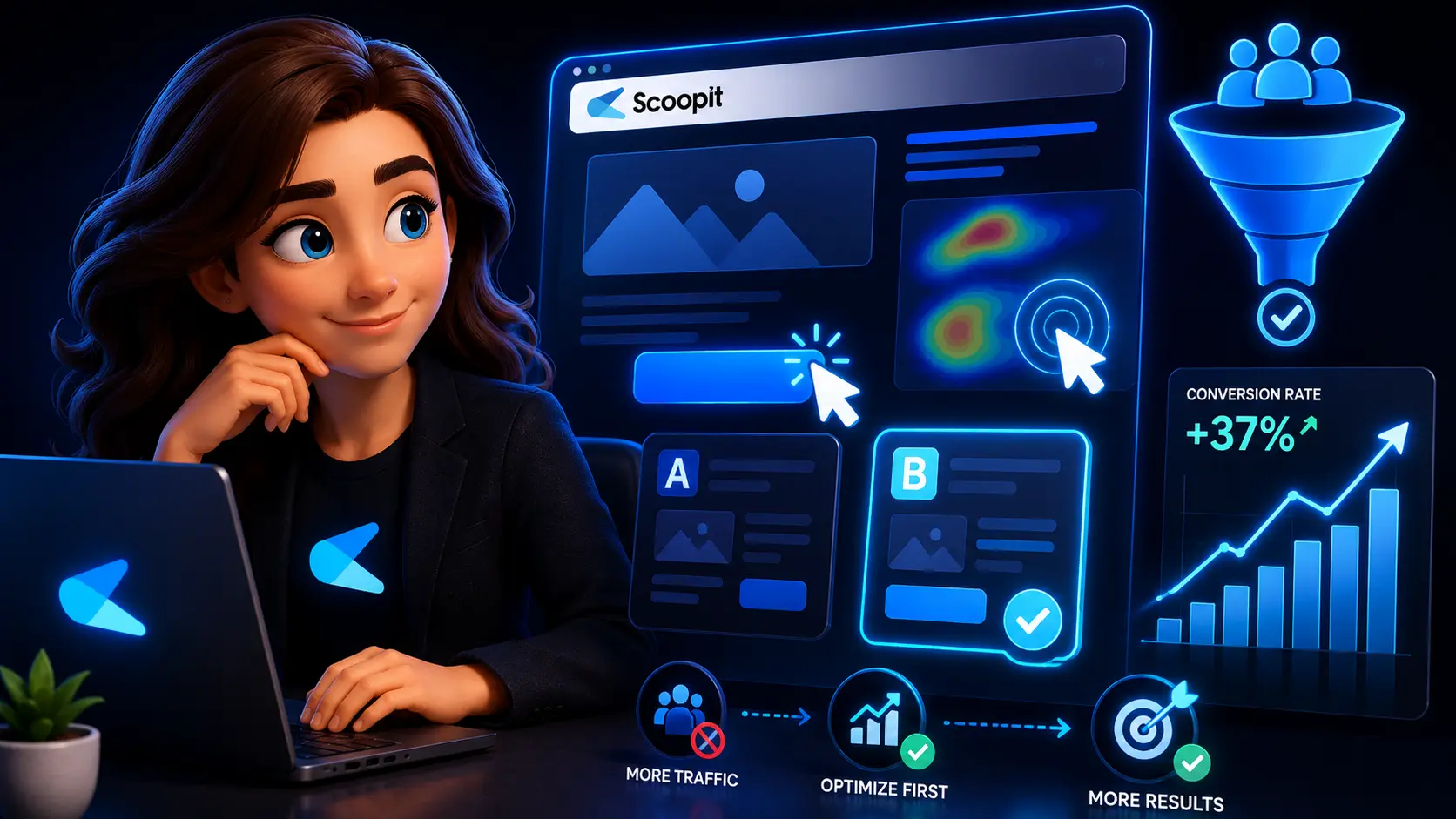
Here’s a scenario that plays out more often than it should: a business invests in SEO, gets more traffic, runs paid ads, pays for every click — and the leads just don’t follow. The numbers look better. The results don’t.
The missing piece is almost always conversion rate optimization.
Before you spend another rupee on traffic, it’s worth understanding whether your website is actually set up to turn visitors into leads. Because if it isn’t, you’re accelerating a leaky funnel.
You Don’t Always Need More Visitors
Let’s do the math quickly.
If your website gets 1,000 visitors a month and converts at 1%, that’s 10 leads. Fix the conversion rate to 3%, without changing traffic at all, and you get 30 leads from the same spend.
That’s what CRO does. It makes your existing traffic work harder.
What Is Conversion Rate Optimization, Exactly?
Conversion rate optimization is the process of improving your website so that a higher percentage of visitors take a desired action, filling out a form, calling you, making a purchase, signing up for a trial, or booking a call.
It’s not guesswork. It’s a structured process of identifying where and why visitors are dropping off, forming hypotheses about what might fix it, testing changes, and measuring the results.
CRO sits at the intersection of data analysis, user experience, and copywriting. Done well, it can have a bigger impact on revenue than almost any other marketing activity.
Read More: Scoopit: Paid SEO Campaigns for Better Lead Generation
The Most Common Reasons Websites Don’t Convert
1. The value proposition isn’t clear in the first 5 seconds: If a visitor lands on your homepage and can’t immediately understand what you do, who it’s for, and why they should care, they leave. Clarity always beats cleverness in web copy.
2. The CTA is buried, or generic “Submit” and “Learn More” are not calls to action. “Get Your Free Audit” or “Book a Strategy Call” are. Specific, benefit-led CTAs consistently outperform vague ones.
3. The page loads too slowly on mobile: Over 60% of web traffic is mobile. A page that takes 4+ seconds to load loses a significant portion of visitors before they see a single word of content. Page speed is a CRO issue, not just a technical one.
4. Forms ask for too much, too soon: Every extra field in your form reduces completion rates. Ask for what you genuinely need at the first step, typically just a name, email, or phone number.
5. There’s no social proof visible: Reviews, client logos, case study results, and testimonials. These reduce anxiety and build trust. If they’re not on your key pages, you’re asking visitors to trust you without evidence.
Core CRO Techniques That Work
A/B testing is the backbone of CRO. Change one element, a headline, a CTA button colour, a form layout, and run both versions simultaneously to see which performs better. Don’t test everything at once, or you won’t know what made the difference.
Heatmaps show you where users click, scroll, and stop reading. Tools like Hotjar or Microsoft Clarity reveal which sections of your page are engaging people and which are being completely ignored.
Trust signal placement matters as much as having them at all. Reviews placed near your CTA convert better than reviews buried in a footer.
Headline testing often delivers the biggest single gains. Your headline is the first thing read and the last thing most businesses actually optimise.
How Long Does CRO Take to Show Results?
Small wins, like fixing a broken form or improving a headline, can show results within days. Meaningful A/B test results typically need 2–4 weeks and sufficient traffic to be statistically valid.
CRO is an ongoing practice, not a one-time fix. The best-converting websites are the ones where someone is always looking for the next improvement.
Conclusion
Getting more traffic to a website that doesn’t convert is an expensive habit. Conversion rate optimization shifts the focus from volume to quality, making sure every visit has the best possible chance of becoming a lead or a sale.
If your website is getting decent traffic but not generating the enquiries you’d expect, it’s worth auditing the conversion experience. Teams like ScoopIt approach website development and optimization with conversion goals built in from the start, not as an afterthought.
FAQs: Conversion Rate Optimization
Q1. What is a good conversion rate for a website?
It varies by industry, but 2–5% is considered a reasonable benchmark for most B2B service websites. eCommerce typically ranges from 1–3%. Highly optimised landing pages can exceed 10%.
Q2. What’s the difference between CRO and SEO?
SEO brings more visitors to your site. CRO makes sure those visitors actually convert into leads or customers. Both are necessary, but CRO improves results from all your traffic sources, not just organic.
Q3. Do I need a developer to do CRO?
Not always. Many CRO changes, headlines, CTAs, form length, trust signals, can be made through a CMS without coding. For A/B testing tools and speed optimisation, some technical help is useful.
Q4. What tools are used for CRO?
Common tools include Google Optimize (or alternatives), Hotjar, Microsoft Clarity, VWO, and Google Analytics 4 for tracking conversion events.
Q5. How do I know if my website has a CRO problem?
Signs include: high traffic but low enquiries, high bounce rates on key pages, low time-on-page, and abandoned forms. A basic analytics audit usually reveals the issue quickly.